Welcome to Your Leadership Waypoint
Leadership is like heading East. You pass many waypoints, but you never actually ‘arrive’. And that is the point.
This blog is a navigational tool for that continuous journey. Drawing on 25 years of experience, I deliver reflections, analysis, and practical tools to help you lead with renewed energy and confidence.
I don’t just offer answers. Every post concludes with a reflective challenge, inviting you to pause, examine your own approach, and ensure your route remains aligned with your values and vision.
Your Leadership Waypoint

Leadership Accountability: How to Stop a Blame Culture and Build Genuine Ownership
In leadership, as on a motorbike, if you drop it, you are the one who has to pick it up. Yet, the corporate world is full of "Teflon Leaders" who expertly deflect blame to protect their egos, silently destroying psychological safety in the process. Here is why owning your mistakes, and absorbing the blow for the ones that aren't technically your fault, is the most powerful, liberating move you can make.
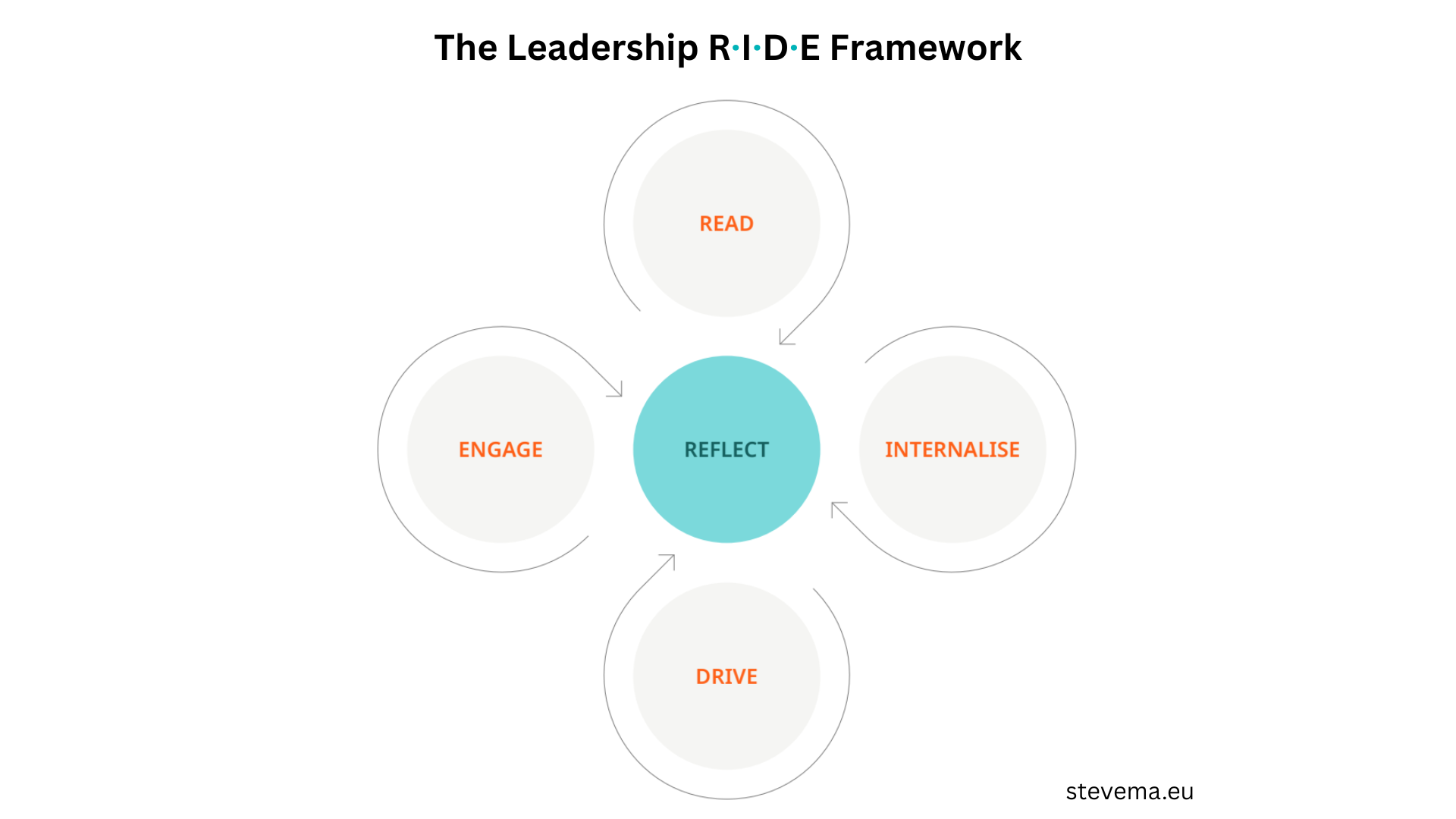
Why Experienced Leaders Stall: How to Break Default Patterns Through Self-Scrutiny
The transition from a reactive manager who survives the noise to a resilient leader who owns the journey happens at a single, stationary pivot point. It is the connective axis of the entire Leadership R.I.D.E. Framework, and it cannot take place whilst you are moving. It requires you to consciously step off the throttle, and look back through the rearview mirror at the track you just left behind.
Human nature naturally resists this glass. Our primitive brains are hardwired to protect our egos, compelling us to look only for validation that supports our existing beliefs. We surround ourselves with corporate confirmation, build comfortable echo chambers, and mislabel it as alignment. Breaking this default requires a manual override of your factory settings, substituting the vanity of unexamined tenure for the raw, repetitive discipline of self-scrutiny.

How to Align Teams and Stakeholders Under Pressure
An organisation cannot pivot when departments pull in opposite directions. In the Your Leadership R·I·D·E Framework, the discipline of ENGAGE shifts the focus from individual command to systemic harmony. By synchronising your team, loosening your grip on control, and navigating strategic alliances with agility, you eliminate structural silos. Discover how to transition from solo effort to collective momentum to build resilience and lead with impact.

Beyond the Death Grip: Why Dynamic Execution Beats a Rigid Five-Year Plan
A rigid five-year strategic plan is a liability when the road turns to gravel. This article introduces DRIVE with Balance, the third discipline of the Your Leadership RIDE Framework. By identifying corporate 'farkling' (bloat) and mastering the 'Friction Zone,' you move from a white-knuckled death grip to a state of dynamic execution. Discover how to shift your operational stance and buy the most precious commodity in leadership: time.

The Novice Mindset: Why the Most Resilient Leaders are Perpetual Students
In the Your Leadership R.I.D.E. Framework, the discipline of INTERNALISE the Journey is the transition from theory to embodiment. By cultivating a Novice Mindset, practicing values as Muscle Memory, and accepting absolute accountability, you ensure your reflexes remain sharp when the terrain turns treacherous. Discover how to recalibrate your ‘Internal ECU’ and move from frantic reaction to a state of resilient command.

How to Master Strategic Vision While Navigating Daily Chaos
This article introduces READ the Road Ahead, the first pillar of The Leadership R·I·D·E Framework. By mastering the tension between the struggles of today and the vision for tomorrow, by focussing clearly on the mission and managing risk, you move from a state of frantic swerving to one of resilient command. Discover how to extend your line of sight to buy the most precious commodity in leadership: time.

How to Lead a Lean Organisation
When headcount is slashed and structures crumble, the natural instinct is to grip the handlebars tighter. But you cannot fix a structural deficit with personal heroics. In this article, Steve Muscat Azzopardi explores why the most effective lean leaders stop trying to fill every gap and start identifying Energy Nodes to clear the path for momentum.

My First Waypoint: What I’ve Learnt About Authentic Leadership Since December.
After twenty years in the corporate 'fast lane', I traded the boardroom for the quieter, deeper work of mentoring. In this milestone reflection, I explore the 'Novice Mindset', the reality of leadership transitions, and why authenticity is a practice.

How to Maintain Leadership Momentum When Plans Fall Apart
As the first quarter closes, many leaders are finding their 2026 plans in tatters. Using a motorbike analogy of "loose wrists", Steve Muscat Azzopardi explores why the toughest road conditions require less control, not more. Includes a reflective "Mirror Check" for your own leadership style.

Can AI Mentor? Why Leaders Need Intuition Over Algorithms
AI can give you an answer, but it can’t give you an anchor. In an era of automated coaching and scripted meetings, we are at risk of hollowing out the next generation of leaders. Explore where AI fits as a training and rehearsal tool, and why the execution of leadership still requires a human soul.

Why Great Leaders Turn Up Their Focus, Not Lower the Volume
Stop trying to quiet the world and start amplifying your intent. Steve Muscat Azzopardi explores why leadership resilience depends on ‘Loud Focus"‘ and somatic awareness to navigate modern boardroom distractions.

A Leader's Guide to Strategic Influence and Resilience
After twenty years in financial services, I’ve seen the same pattern: technical brilliance alone doesn't sustain leadership. To stay at the head of the table, you must master the art of modulation: knowing when to drive forward and when to create space for your team to innovate. Here is how we move from management theory to leadership execution.

What is Mentoring?
Steve Muscat Azzopardi explores the shift from managing tasks to mentoring potential. Learn how to build trust and autonomy in your team.