Why Experienced Leaders Stall: How to Break Default Patterns Through Self-Scrutiny
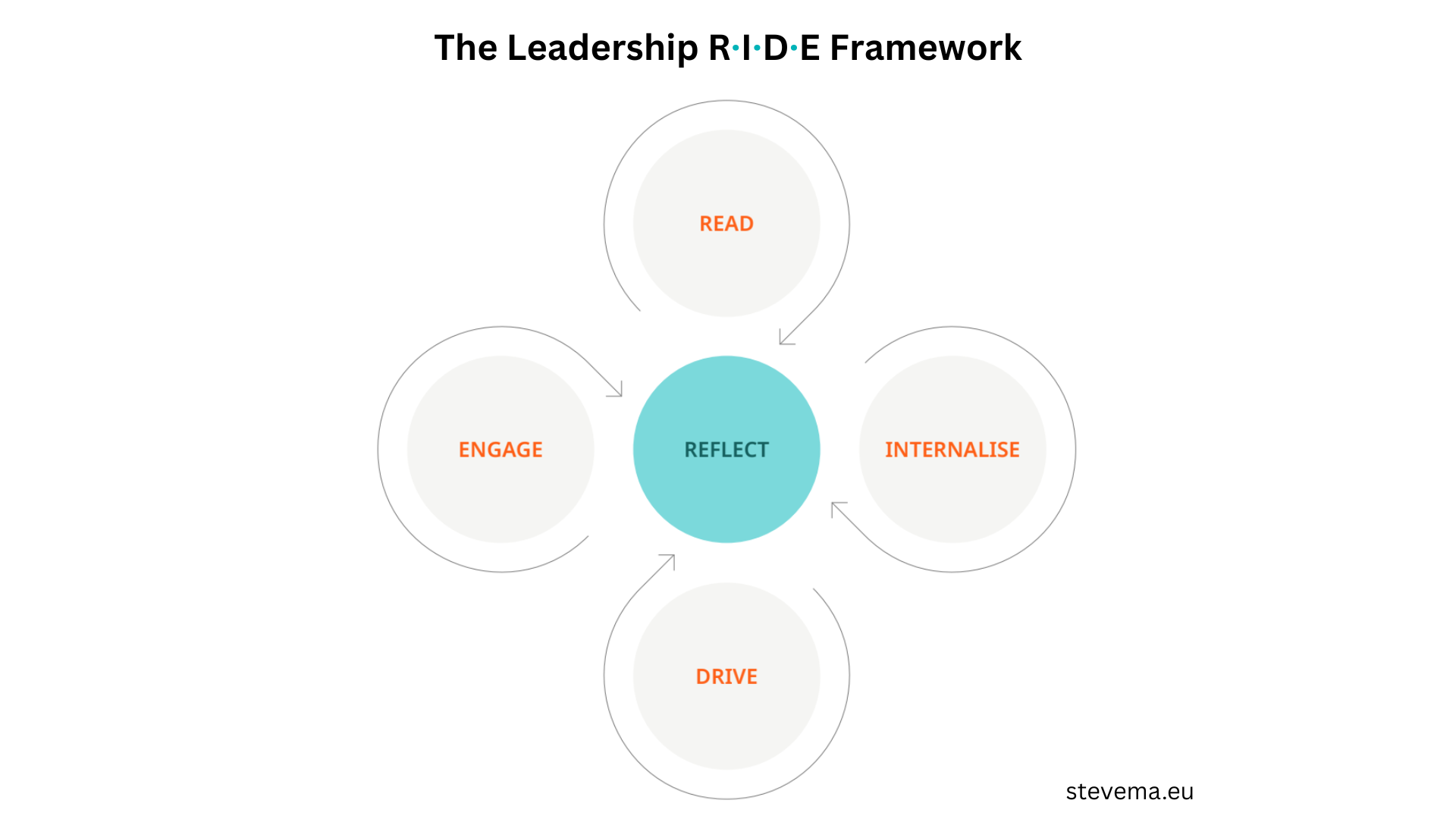
Reflection is where the four disciplines converge.
Every executive is trying to figure out how to take the corners of modern business a little faster. We pack our schedules with meetings, download the latest app, and gorge on strategy playbooks, operating under the comfortable assumption that simply logging more corporate miles makes us wiser. We treat the passage of time as if it automatically distills into leadership competence.
The reality is that we get better at doing something not by doing it repeatedly, but by critically and honestly appraising our performance and challenging ourselves.
The transition from a reactive manager who survives the noise to a resilient leader who owns the journey happens at a single, stationary pivot point. It is the connective part of the Leadership R·I·D·E Framework, and it doesn't take place while you are moving. It happens when you stop, and look back through the rear-view mirror at the track you just left behind.
The Central Axis of The Leadership R·I·D·E Framework
When I mapped out The Leadership R·I·D·E Framework, the four disciplines - Read, Internalise, Drive, and Engage, fell into place like the natural components of a machine.
Read gives you the vision to scan the external horizon.
Internalise builds the muscle memory of the rider.
Drive converts strategic intent into operational forward thrust.
Engage aligns your team to move in perfect synchronisation with your leadership.
In the model, those four circles do not exist in isolation. They all return to a central axis that binds the entire system together: Reflect.
Without this central hub, the entire wheel spins out of balance. You can design the perfect strategic plan (Read), build an innovative culture (Engage), and push forward with dynamic execution (Drive), but without honest self-appraisal, you repeat old patterns while hoping for better results.
Wiser leadership does not come from a starting point of underperforming or being "weak" at something. The search for continuous improvement isn't born from deficit; it is born from mastery. Much like a seasoned biker can always take the exact same curve a fraction more smoothly, more fluidly, and with more effortless control, we reflect because we know our best line is still out there waiting to be discovered.
“Experience alone does not distill into competence; logging corporate miles without self-scrutiny just makes us highly efficient at repeating our old mistakes.”
Polishing the Mirror: Three Practices for Leadership Self-Reflection
The challenge is that human nature resists the mirror. Our primitive brains are hardwired to protect our egos, compelling us to look only for views and data that support our existing beliefs. We therefore surround ourselves with confirmation, build comfortable echo chambers, and label it alignment.
To scrape the rust off our judgment and turn experience into genuine wisdom, we must manually override our factory settings. Here are three ways to do that:
Invite dissenting opinions. It is comfortable to lead a room where everyone nods in agreement, but consensus can lead to blindness. Challenge yourself to intentionally seek out the perspectives that make you uncomfortable. Lean into the views of thought leaders you tend to disagree with, or schedule time with that team member you usually try to avoid because their critique feels irritating.
Curiosity before judgement. When you enter these discussions, leave your defensive armour at the door. Suspend your judgement, silence your internal counter-arguments, and listen with open curiosity. If someone thinks radically differently to you, your job is not to correct them, it is to understand what they see that you are blind to.
Practice the Discipline of Micro-Reflection. Reflection does not need to be an away day, or a lengthy exercise where you look back over the last week with a critical lens. Build a habit of micro-reflection. Start taking a minute or two just after a meeting or exchange to consider. Did you say something that landed well? What was it and why did it work? Or did you lose your audience at one point? What could you have done differently?
Note these micro-reflections and look at them all once a week. Your patterns will guide where you need to modify your approach.
The Ultimate Accolade: Building a Resilient Leadership Legacy
When you finally step away from your role and hand over the keys for the last time, what will you leave behind? Will it be a depleted team, burnt-out operations, and a legacy of white-knuckled friction? Or will you leave the road safer, the route clearer, and the crew stronger for the next leg of the journey?
Judgment is not a gift of seniority; it is a muscle encoded through practice. Just as a rider doesn't master cornering by reading about it, you build leadership wisdom through the raw, repetitive work of self-scrutiny.
When you look into the rearview mirror of your career, the corners you overcooked or the moments you dropped the bike shouldn't be sources of shame, they are the spaces where your resilience was forged. However, the scar only turns into a lesson if you have the humility to study it.
Mirror Check
Open your notebook right now and answer one question by hand, slowing down your mind enough to let the real data surface: What is one leadership default or process you are stubbornly defending right now, simply because "it is how I have always done it"?
This is a glimpse into REFLECT, the connective hub of the Leadership R·I·D·E framework.
This article is the fifth and final waypoint in a five-part series exploring the Leadership R·I·D·E Framework - the core of my upcoming book.
If you are ready to move beyond the exhaustion of constant reaction and start building resilience and leading with impact, I invite you to join the journey early. More than a book launch; it’s a community of leaders committed to a more profound embodiment of leadership, one that allows you to flex under pressure without breaking.
Sign up for Early Access to receive:
The ECU Sneak Peek: Be the first to receive the final chapter on REFLECT (the systemic hub that connects the framework) before the book hits the shelves.
Pre-order Priority: Ensure you’re at the front of the formation when the book launches.
Thank you for reading this far. If any of this resonates, I’d love to welcome you as a reader and to stay connected. Please join the mailing list for future posts, share your thoughts in the comments, or find me on LinkedIn.
