Leadership Accountability: How to Stop a Blame Culture and Build Genuine Ownership

Ownership points the way forward.
Executive Summary: In leadership, fault focuses on who caused a problem, whilst responsibility focuses on who owns the solution. Great leaders accept that whilst a crisis may not be their fault, fixing the system and culture that allowed it to happen is always their responsibility. Overcoming a blame culture requires leaders to shift their focus from defending their ego to actively fixing the problem.
The Psychology of Blame: Why Leaders Default to Excuses
When out riding and you find yourself in a dangerous situation, the human brain has a reflex. It wants to blame the infrastructure agency for not maintaining the road, or building the road too narrow. It wants to blame the tyres, the weather, or the shadow from the trees.
The truth is that I chose to get on the bike. I chose the route and the speed.
If I find myself in a sticky spot, there is no one else to help and it is entirely my problem.
Early in my career, I let this instinct run into my work. I used to think that finding out whose fault something was solved the problem. It took time, and a fair bit of failure, to realise there is a massive, structural difference between fault and responsibility.
“Blame protects your ego at the cost of your team. Ownership protects your team at the cost of your ego.”
The Teflon Leader vs. The Accountable Leader
In a complex team environment, it might not be your fault that a junior staff member sent the wrong file. You didn't personally press the button.
But if you are the leader, it is absolutely your responsibility.
You are responsible for the training that person received.
You are responsible for the system checks that failed.
You are responsible for the culture that either encouraged them to double-check their work or pressured them to rush.
We have all worked with a "Teflon Leader", the kind of boss to whom nothing ever sticks. When the sales figures are down, it’s the market’s fault. When a project runs late, it's the supplier's fault.
The problem with this mindset is that if you say, "It's the market's fault," you are helpless until the market changes.
Ownership Empowers
On the other hand, if you say, "It's my responsibility that we didn't anticipate the market shift," you empower yourself to change the strategy.
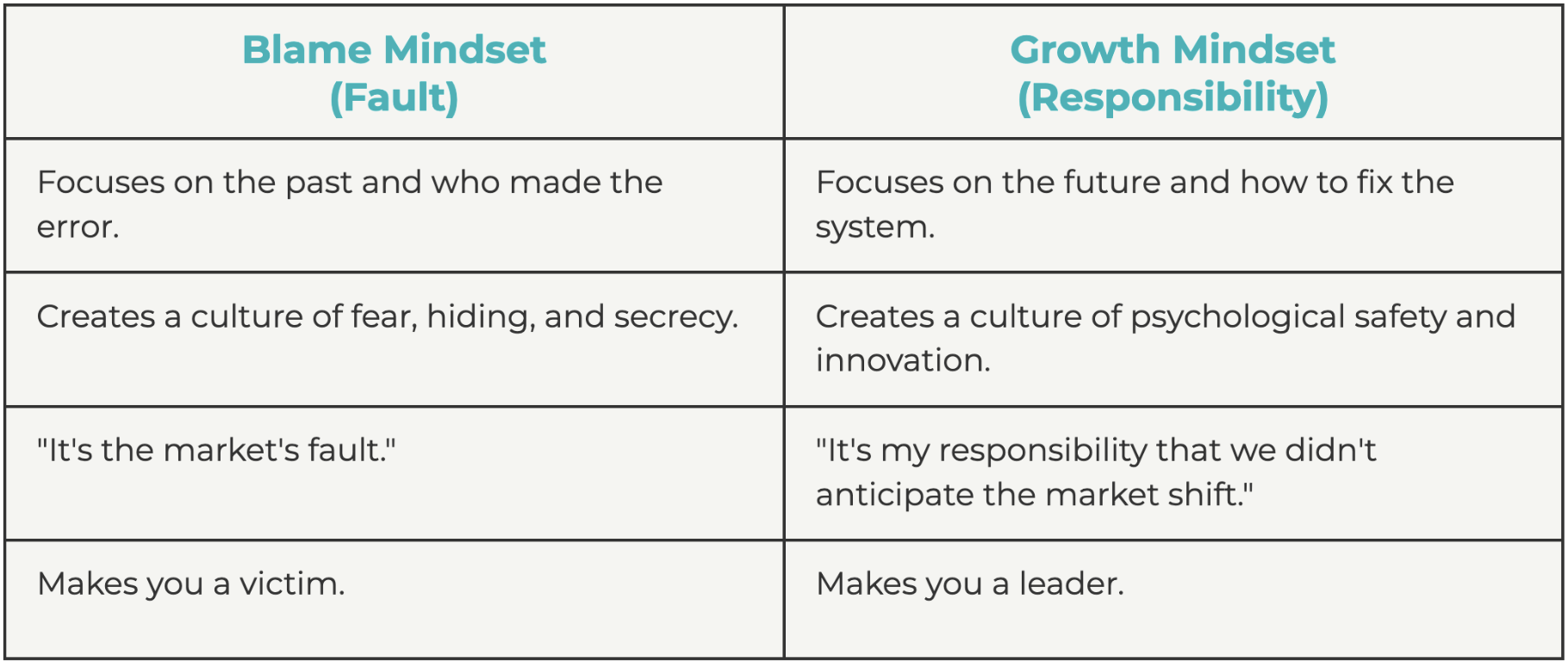
Blame protects your ego at the cost of your team. Ownership protects your team at the cost of your ego.
When you stop wasting energy looking for blame and start to focus entirely on the resolution, you travel light and make faster progress.
Mirror Check:
The next time you face a crisis, pause and ask yourself a simple question: Am I currently describing why it happened (fault), or am I describing how we fix it (responsibility)?
Are you riding, or are you just a passenger in your own career?
If your organisation is stuck in a cycle of blame, or if you are ready to elevate your own leadership resilience, let’s talk. Reach out to me for 1:1 executive mentoring, and together we will build the clarity, integrity, and accountability needed to get your team moving in the right direction.
Thank you for reading this far. If any of this resonates, I’d love to welcome you as a reader and to stay connected. Please join the mailing list for future posts, share your thoughts in the comments, or find me on LinkedIn.
