What is Mentoring?

Mentoring is a shared ride. The mentor to set the pace and the mentee commits to the climb, moving in rhythm toward a common horizon.
Have you ever had a mentor, or been one yourself?
For a long time, I assumed that being a mentor was part of the role of a manager or leader. That illusion lasted until I worked for a couple of leaders who did nothing to help me grow.
Reflecting on my own track record, I recognised the same pattern. As a manager, I trained my team on technical skills and processes, but not on how to develop, how to think more critically, gain confidence, or take ownership.
This post is my attempt to explore what mentoring really means, how it differs from managing or leading, and why mentoring is so rewarding to both mentee and mentor.
Leadership is not Mentoring
In those early days, I was far more directive than I wanted to be. That’s how I had always been managed, and in private wealth management, mistakes are costly. Every error meant wearying hours writing file notes and justifications to the Board.
My response was to tighten control. I became a stickler for detail and documentation, even though that rigidity goes completely against my nature. Ironically, it worked: the team was precise, and we reduced errors.
The problem was that I had to be there to give instructions. When I went on vacation, problems occurred. My team relied on me too much, and I realised, painfully, that I had not built a culture of trust.
My First Mentor
This all changed for the better when I got a new manager, someone who became my first real mentor. He challenged me to think for myself, to take ownership, and to trust my own judgement. He backed me up when I made decisions, even when I got it wrong. That trust was liberating and it transformed me.
In turn, I started leading my team the same way. Within months, autonomy grew. Decisions were made without me and mutual trust replaced dependency. I felt like a true leader rather than a nagging controller and realised: a manager directs people; a mentor develops them.
From Manager to Mentor
Mentoring is an art that demands more than a title. It requires active listening, empathy, and the humility to realise your way is not the only way. While a manager ensures the work gets done, a mentor invests in the evolution of the person.
To move beyond informal coffee chats, effective mentoring needs a structured framework with measurable milestones. This creates accountability and ensures the relationship stays purposeful rather than drifting. Mentees need time for reflection and to implement insights into action.
“A manager directs people; a mentor develops them”
Mentoring: A Shared RIde
Mentoring is a mutual journey. Mentees must be ready to be challenged and examine themselves critically. In return, they gain perspective and confidence. The mentor also benefits, gaining deeper self-awareness, and the satisfaction of contributing to another’s success. It’s a ripple effect that builds stronger, more resilient teams and a culture of trust. I’ve grown as much from the people I’ve mentored as they have from me.
Moving from Theory to Action
Understanding the difference between directing and developing is the first step, but shifting gears in a high-pressure environment requires more than intent. Based on my experience transitioning from a rigid controller to a mentor, here are three ways to start loosening your grip today:
Audit your "Holiday Readiness": If your team cannot make decisions in your absence, identify one recurring approval you can delegate entirely this week.
Ask, Don't Advise: when you are next asked for help, challenge yourself to ask "How would you handle this?" before offering your own solution.
Create a Mentoring Waypoint: Dedicate a specific, recurring 60-minute "pit stop" in your calendar solely for your team's long-term development, separate from project updates.
Manager vs. Leader vs. Mentor: What’s the Difference?
The table below shows my view of how the roles interplay. Understanding this nuance is key to becoming someone who leads with lasting impact or indeed becoming a mentor.
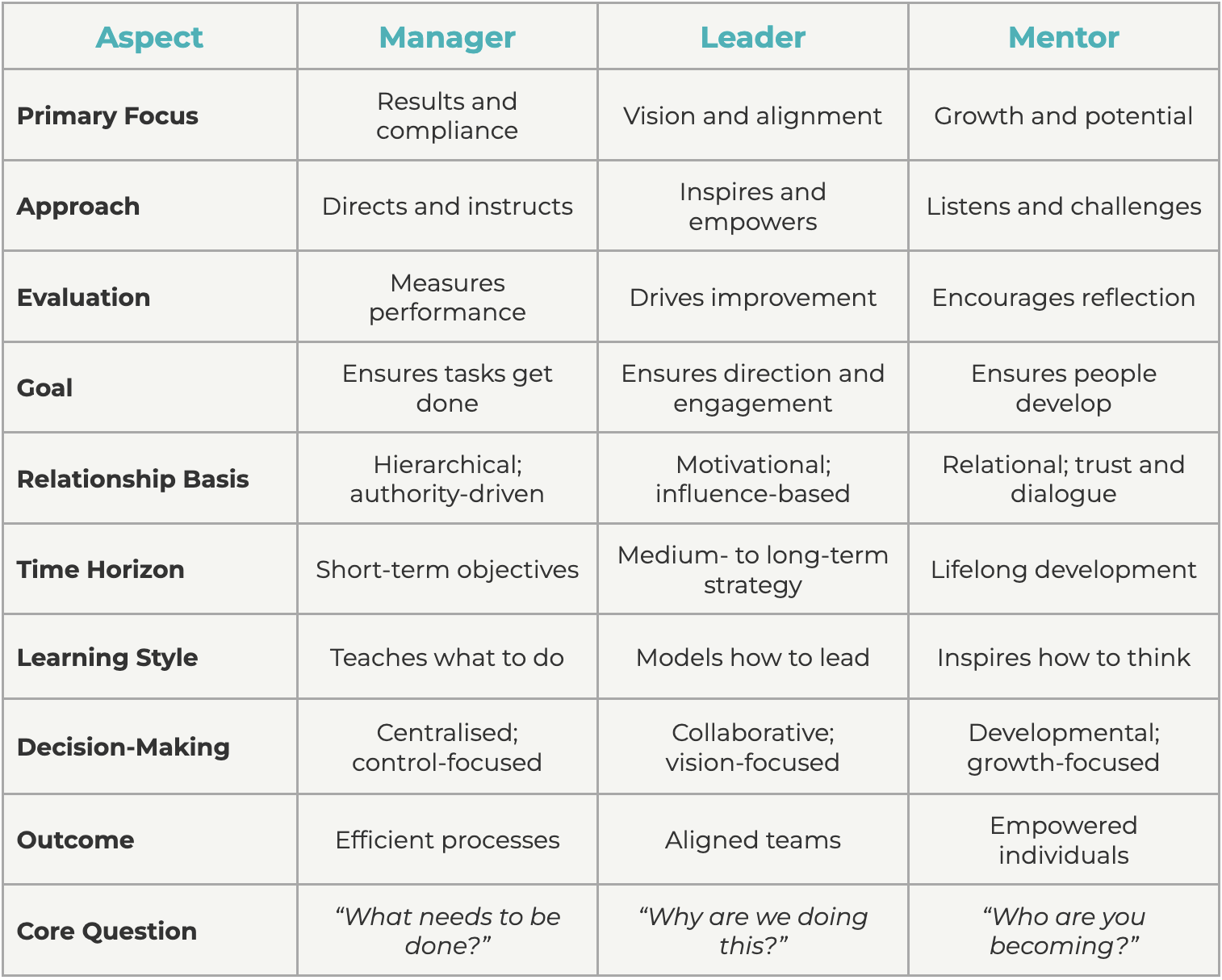
Table illustrates the transition from task-based management to person-centered mentoring.
A Last Reflection
Seeing it laid out like this, I realised my own journey mirrored that shift: from managing tasks, to leading people, to mentoring potential. Each stage built on the last, but it was mentoring that finally connected performance with purpose.
Your Ride
If you are ready to empower your team through structured mentoring, let’s talk. Whether you are seeking 1:1 Mentoring to elevate your own impact, wish to become a Mentor yourself, or considering a Bespoke Mentor programme in your organisation I can help you find your line.
Question for you managers and leaders: are you leading to direct, or leading to develop?
Thank you for reading this far. If any of this resonates, I’d love to welcome you as a reader and to stay connected. Please join the mailing list for future posts, share your thoughts in the comments, or find me on LinkedIn.
